teltec Sustainable Solutions
Globally Effective Climate Protection Made in Switzerland
We enable low-carbon technology transfer by linking Swiss engineering know-how with local needs in developing countries — practical, scalable and locally beneficial.

Value proposition
Low-carbon technology transfer with measurable local and global impact.
As a separate project organization of teltec systems ag, we develop and support sustainable solutions aligned with the UN Sustainable Development Goals.
We link innovative ideas with local needs — from concept development through technical validation to scalable business models.
Climate-relevant technology-transfer concepts
Swiss and local implementation networks
Technical, economic and environmental objectives
Effective climate protection
Why global engagement matters
Climate protection in Switzerland is progressive, but its global leverage is limited without cross-border action. The decisive step is technology transfer into developing countries — before fossil-based infrastructure becomes locked in.
Why?
Global emissions cannot be solved by developed countries alone. Climate protection must reach regions where future infrastructure is still being built.
How?
By developing clean-tech solutions with local stakeholders and building business models, training structures and policy-compatible implementation pathways.
Impact
New markets for greenhouse-gas-free solutions emerge locally. Climate protection becomes part of economic development and sustainable prosperity.
Illustrative project
Pioneering Solar Innovation in Maritime Transport
Empowering sustainable fishing in Puger, Indonesia, through solar-electric propulsion, patented EVA foam construction and local implementation capacity.
Solar Electric Fishing Boat for Indonesia
The Solar Electric Fishing Boat project supports the transition of small-scale fisheries in Indonesia from fossil-fuel-based operation to solar-electric maritime transport. It combines solar-electric propulsion, an innovative EVA-based hull concept and a decentralized manufacturing approach designed for local implementation.
In Puger, East Java, thousands of small fishing boats operate in demanding coastal conditions. Many depend on diesel engines, manual fuel supply and conventional wooden or fiberglass hulls. This creates high operating costs, dependency on fuel availability, local pollution, noise and recurring maintenance challenges.
Our mission is to create lasting positive change by empowering small-scale fishing communities, strengthening economic resilience and promoting environmental sustainability.
Project focus
- Reduce diesel dependency and fuel-cost exposure
- Lower operating and maintenance costs
- Reduce CO₂ emissions and local pollution
- Improve repairability and local production potential
- Prepare a replicable model for clean maritime transport
The problem
Fuel dependency and high daily costs reduce the economic resilience of small-scale fishing households.
- High gasoline and diesel costs
- Fuel constraints in remote areas
- Profit absorbed by fuel expenses
The solution
A low-cost solar fishing boat based on patented EVA foam construction and solar-electric propulsion.
- Lower operating costs
- Less environmental pollution
- Better living standards for fishers
The product
A robust solar-electric boat concept built around Indonesian small-scale fishing needs.
- Affordable lifecycle cost
- Durable in salty, wave-exposed conditions
- Easy to operate and repair
Technology approach
Solar-electric propulsion combined with an EVA-steel hybrid hull.
- Solar-electric drive system: designed for low-speed, high-torque fishing operation
- Energy management system: battery monitoring, reserve thresholds, user display and operational data logging
- EVA-based hull concept: buoyant, robust and designed to reduce maintenance complexity
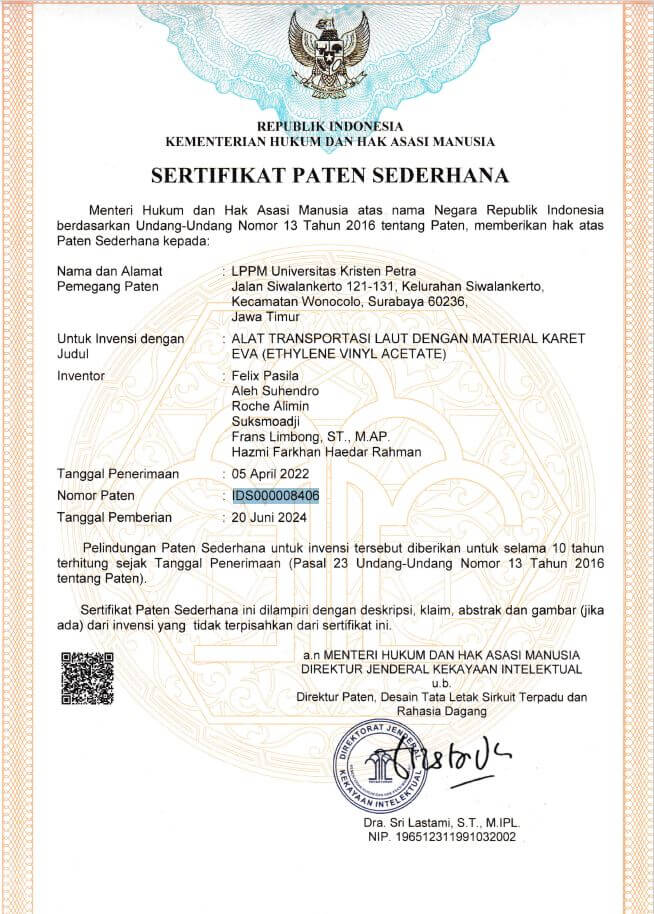
- Patented construction: Indonesian patent granted, PCT in progress
- Modular design: locally sourceable components where possible
- Certified: Indonesian Maritime Authority, January 2024
Project overview
We develop an efficient full solar-electric boat for fisheries in Indonesia to reduce CO₂ emissions, lower environmental damage and improve the economic resilience of small-scale fishing communities.
Read more:
From prototype validation to scalable implementation
Engineering optimization, testing and replication readiness.
Earlier prototypes demonstrated technical feasibility. The second prototype was certified by the Indonesian Maritime Authority in January 2024 with positive feedback on stability, maneuverability and low-noise operation.
1. Technical readiness
Develop a robust, production-oriented solar-electric fishing boat adapted to Indonesian operating conditions.
2. Local implementation capacity
Strengthen manufacturing, assembly, maintenance and training structures in Indonesia.
3. Replication potential
Prepare the technical, organizational and business conditions for deployment beyond the first prototypes.
Replication pathway
The long-term objective is to support a decentralized implementation model — local production, assembly and service capacity instead of imported complete boats.
- Optimized prototypes as reference models
- Training packages for local technicians and workshops
- Quality assurance procedures for repeatable production
- Certification dossiers and technical documentation
- Licensing and cooperation models with Indonesian partners
Measured impact
Impact must be measurable for solutions to scale. The project tracks indicators such as installed solar capacity, diesel reduction, CO₂ savings, operating-cost savings and training readiness.
- Installed solar PV capacity on prototype boats
- Renewable energy produced per year
- Diesel fuel avoided through electric operation
- CO₂ emissions reduced vs. conventional operation
- Number of trained local participants and partners
Impact / how we can make a difference
Climate protection as an opportunity for sustainable development.
Clean technologies must create value locally to scale. Climate protection is not a restriction — it is an opportunity for economic development, technical education and improved living conditions.
Greenhouse-gas-free solutions emerge locally and create lasting economic opportunity.
Developing countries participate in sustainable economic growth on their own terms.
Know-how, cooperation and technology-transfer capability — made in Switzerland.
Alignment with the UN Sustainable Development Goals
The project contributes across multiple sustainability dimensions: poverty reduction through lower operating costs, clean energy use, decent work and local skills, responsible production, climate action and marine ecosystem protection.
No Poverty
Clean Energy
Decent Work
Innovation
Responsible Production
Climate Action
Life Below Water
Partnerships
Key members
Thomas Anner
CEO teltec systems ag. Project lead — development, Swiss coordination, proposal structuring and technology-transfer partnerships.
Markus Tellenbach
Management and Board Member teltec systems ag. Supports strategic management, governance and long-term project positioning.
Christian Adinegoro
Chairman of Swiss Indonesian Business Partnership. Supports Indonesian stakeholder access, partnership development and local coordination.
Mark Wüest
Solar boat designer and builder, founder and technical manager of MW-Line SA. Practical expertise in solar-electric boat design and operation.
Silvia Ulli-Beer, Dr. oec.
Co-Lead Sustainable Energy Systems, ZHAW School of Engineering. Lecturer for Innovation and Sustainable Business Models.
Felix Pasila
Founder Solarboat Maritim Indonesia, Associate Professor in Electrical Engineering at UK Petra. Indonesian innovation and technical implementation.
Roche Alimin
CEO Solarboat Maritim Indonesia. Indonesian operations, technical implementation and local production preparation.
Team project experience
- First solar-powered vessel to complete a transatlantic crossing
- Construction of more than 30 solar boats for public transport, private customers and experimental initiatives
- Renewable energy entrepreneurship initiatives and international project development
- Project management, sourcing, actor coordination, networking and administration
- Development of sustainable energy and technology-transfer concepts
- Industrial experience in energy efficiency, production technology and system integration
- Applied research on energy technology change and future energy systems
- Energy strategy development and assessment at local, regional and industrial level
- Sociotechnical evaluation of regional energy systems
- Long-term policy analysis in support of sustainable energy systems
- Multiple applied patents, granted patents, PCT patent experience and copyrights
- Entrepreneurial experience in Indonesian innovation ventures and maritime technology
Cooperation for practical climate solutions
We welcome cooperation with technical partners, development organizations, implementation partners, foundations, public institutions and companies interested in practical climate solutions for emerging markets.
Contact us to discuss project cooperation, sustainable technology transfer and implementation partnerships.
Contact
Thomas Anner
teltec systems ag / teltec Sustainable Solutions
Mail: thomas.anner@teltec.ch
Phone: +41 79 314 13 76
teltec Sustainable Solutions
Low-carbon technology transfer
Solar-electric maritime innovation
Swiss engineering and international cooperation
 I agree and would like to subscribe to the free newsletter